
Showing posts with label Festivals. Show all posts
Showing posts with label Festivals. Show all posts
Monday, April 11, 2011


Sunday, April 10, 2011

Wednesday, March 2, 2011
Night of Awakening from Dream of Maya

Shivaratri is a call for awakening- from the dream of Maya. Shiva is auspiciousness. When the mind becomes silent and merges with the Self it is called Shivaratri.
Shiva means - that which is not. Emptiness is the womb of creation.
Tiny galaxies float in this vast emptiness.
Namaha means jeeva surrendering to Shiva.
Aya means oneness.
Om Namaha Shivaya = Jiva is nothing but Shiva. = Tatwamasi.
Shiva with Form
Na, Ma, Shi, Va,ya - Five Aksharas of Panchakshari Mantra represents -
Pancha Bhutas - Pancha tanmatras, Pachendriyas all aspects of
creation. It represents the five aspects of Dance of Shiva - Sristhi, sthiti, Samhara, Tirodhana and Moksha - Five facets of Shiva - Sadyojata, Vamadeva, Ishana, Aghora, Tatpurusha.
Form and Formless
God is both with form and formless. This is beautifully depicted by
Shivalinga.
Linga stands for indicator - symbol. Shiva linga symbolizes formless
and form aspect of divinity.
Form comes from the nature - prakriti. This is the peetham of
Shivalinga. Formless aspect is shown by the elliptical structure of
Shivalinga.
Mythological Stories associated with Shivaratri
Purana story 1 : Shivaratri celebrates union of Shiva and Parvati -
signifying the beginning of Creation.
Purana story 2 : Shivaratri celebrates penance of Parvati for husband.
Purana story 3 : Shiva emerging as lingodbhava murthy on night of
Shivaratri.
Purana Story 4 : Shiva capturing Ganga in Jata - celebrated by
Abhishekam.
Purana Story 5 : Poisson emerged out of Samudra Manthan - Shiva saving
the world.
Shivaratri Celebration
Sivaratri, dedicated to Lord Shiva, is celebrated on the moonless night of the month of Phalguna, which is the fourteenth day in the krishnapaksha or dark half. Owing to a special planetary conjunction, spiritual practices done on this day are considered to be especially auspicious and beneficial. There is a reference to this in one of the Puranas, where Shiva himself tells Parvati Devi [the Divine Mother] that this day is particularly dear to him, and that those who perform the prescribed austerities on this day will be freed from all sins.
One popular story from the Puranas goes like this: There was once a poor hunter from Varanasi. His name was Suswara. He lived with his wife and child in a small hut. Theirs was a hand-to-mouth existence. Suswara would go to the forest and hunt whatever game came his way, and thus feed his family. One particular day, he caught many small animals and birds, which he put into a sack. Encouraged by the catch, he wandered deeper into the forest in search of more game. Soon darkness set in and he turned to go home. He was a little worried as the forest was infested with dangerous animals. He did not like the idea of spending the night there. Soon it became very dark. Unable to find his way back, Suswara climbed a tree to be safe from the wild animals.
Attracted by his scent, animals came lurking under the tree. Hoping to scare them away, Suswara plucked some twigs from the tree and threw them at the animals, but to no avail. Throughout the night the animals kept prowling beneath the tree.
Suswara was unable to get even a wink of sleep. He kept vigil throughout the night. He plucked leaves from the tree, which happened to be a bilva tree, and dropped them on the ground. Unknown to Suswara, there was a Shivalinga at the foot of the tree; and so, although he was unaware of it, by dropping the sacred bilva leaves, Suswara was making a sacred offering to the Shivalinga. That night happened to be Shivaratri. So the hunter had unknowingly kept a night-long vigil and worshipped Shiva.
According to the Shiva Purana, the Mahashivaratri worship should incorporate six items: offering bilva leaves to the deity after giving it a ceremonial bath, which represents purification of the soul; applying vermilion paste on the linga after bathing it, which represents virtue; offering food, which is conducive to longevity and the gratification of desires; lighting incense, which yields wealth; lighting an oil lamp, which signifies the attainment of knowledge; and offering betel leaves, which marks satisfaction with worldly pleasures. These six items form an indispensable part of the Mahashivaratri worship, be it a simple ceremony at home or grand temple worship.
Significance of the Rituals
The story above is an allegory. Just as the hunter sought to kill wild animals, the spiritual seeker tries to overcome lust, anger, greed, infatuation, jealousy and hatred. The jungle is the mind where all these negativities roam about. A spiritual aspirant must kill these "animals" to be free.
The name of the hunter was Suswara, which means "one of melodious voice." This indicates the purity of intent and speech, which, in turn, imply a level of mental purity.
The hunter was born in Varanasi. Vara refers to the forehead while nasi is the nose. The point where both meet is Varanasi, in other words, the point midway between the eyebrows. This point is also called the ajna chakra and is regarded as a nexus of the three nadis: ida, pingala and sushumna. A spiritual aspirant who concentrates his or her mind on this point gains concentration and gradual control over his senses. The killing of the animals thus indicates control over one's vasanas [latent tendencies].
The bilva tree corresponds to the spinal column. The tree's leaves are special: each stalk has three leaflets. The three leaflets represent the three nadis mentioned above. The climbing of the tree represents the ascent of the kundalini shakti from the muladhara to the ajna chakra.
Keeping awake is symbolic of the kind of awareness and oneness of purpose that a spiritual aspirant needs to reach the goal. He cannot afford to be slack even for a moment.
Shiva is the Supreme Consciousness that illuminates the three states of waking, dreaming and deep sleep. Offering the threefold bilva leaves to the Shivalinga heralds the return to a level of consciousness beyond the three states, which is the fourth state, turiya. The dawning of that state is consonant with the awakening of the individual
Meditation on Form of Shiva
 Trishul in right hand of Shiva - Represents 3 Gunas - Satva, Rajas,
Tamas. Three Gunas Rule the world.
Damaru in his left hand represents the Sabda Brahman.
Ganga flowing out of Shivas Jata represents - Jnana Ganga - Nectar of
wisdom one which purifies and brings immortality.
Crescent moon on Shivas head represents the - mind. Mind is the
ornament for Shiva (Tormentor for Jiva).
Shiva wears the elephat skin - Elephant represents vritti - ego/
thoughts. Shiva has mastered these.
Shiva is sitting on tiger skin - Tiger skin represnts animal
tendencies. Shiva has conquered these.
Shiva holds deer in one hand. - Deer represents the chanchalata -
restless mind. Shiva has controlled the restlessness of mind.
Shiva is white in colour - representing simplicity, purity.
Vibhuti represents - 3 vasanas to be burnt - Loka vasana, deha
vasana, shastra vasana representing the three Granthis - Brahma,
vishnu, rudra granthis.
It also represents burning of three illusions - karmamala, mayiya
mala, anava mala
Balipeetha infront of Shiva represents - sacrificial alter where we
have to sacrifice the ego.
Bull - Nandi -vehicle of Shiva represents the Dharma.
Maha Shivaratri- 2nd March 2011

Shivaratri is the day when Shiva emerged as Lingodhbhavamurthy from
his formless state to participate in the creation. Devotees wait for
offering bilva leaf to Lingodhbhavamurthy at 12 pm.
Lingodbhavamurthy is an iconic representation of Shiva, installed in
the rear devakoshta (niche) of the garbagriha (sanctum) of all Shiva
temples.
The story of Lingodbhavar is based on the attempts of Vishnu and
Bhrama to discover the origins (the beginning Aadi and the end Antha)
of Shiva. While Vishnu and Brahma were arguing about their superiority
over one another, a huge lingam of fire appeared before them. Curious
to trace the origins of this column of fire, Bhrama assumed the form
of a swan and flew upwards, while Vishnu assumed the form of a boar,
and burrowed down into the earth. Days of search in either direction
proved futile, and hence the duo surrendered to this column of fire
with prayers. Shiva then appeared out of this column of fiery lingam,
with a thousand arms and legs, with the sun, moon and fire as his
three eyes, bearing the pinaka bow, wearing the hide of an elephant,
bearing the trishul, and addressed Vishnu and Bhrama in a thunderous
voice, explaining that the two were born out of him, and that the
three were then separated out into three different aspects of divinity
The manifestation of Shiva in this column of fire in front of Bhrama
and Vishnu, is carved in stone, as the Lingodbhavamurthy manifestation
of Shiva, and is always enshrined in the rear niche of the sanctum
enshrining a Shivalingam. Since most temples face east, Lingodbhavar
faces West.
Thursday, January 13, 2011
Path of Light - Makara Sankranti.
 Wish you all Very Happy Makara Sankranti.
a). What is the significance of Makara Jyothi in Shabari Malai ?
Traditionally, during Uttarayana punya kala, piligrims gather to see the Light - Makara Jyothi in Shabari Malai. The light symbolizes "The Path of Light - Uttarayana Marga" as described in Bhagavadgita ( see the article below). There are two paths for human beings - Path of Light - Devayana/Uttarayana and path of darkness ( pitrayana). Makara jyothi is a call for all of us to follow the path of light - Spiritual path. For the details of this path see the message of Makara Sankaranthi for 2010 given below.
Spiritual Meaning of Myths associated with Makara Sankranthi
1). According to the Puranas, on this day Surya(Sun) visits the house of his son Shani(Saturn), who is the lord of the Makar rashi(Zodiac Capricorn). Though the father and son duo did not get along well, the Surya made it a point to meet his son on this day. He, in fact, comes to his son’s house, for a month. This day thus symbolizes the importance of the special relationship between father and son.
Spiritual Meaning : Sun stands for Karma. Sun is Adhidevata for Karma while Shani is the adhidevata for karma phala. Makara Sankranthi is the day we have think of the path which we are going to chose - Path of light (Nishkama karma) represented by Sun or path of darkness (kamya karma) represented by Shani.
2). It was on this day when Lord Vishnu ended the ever increasing terror of the Asuras(Demons) by finishing them off and burying their heads under the Mandara Parvata.
Spiritual Significance : This occasion also represents the end of ‘negativities’ and beginning of an era of righteous living leading to Path of Light (Uttarayana).
3). Maharaja Bhagiratha, performed great penance to bring Ganga down to the earth for the redemption of 60,000 sons of Maharaj Sagar, who were burnt to ashes at the Kapil Muni Ashram, near the present day Ganga Sagar. It was on this day that Bhagirath finally did tarpan[clarification needed] with the Ganges water for his unfortunate ancestors and thereby liberated them from the curse. After visiting the Pataala(underworld) for the redemption of the curse of Bhagirath’s ancestors the Ganges finally merged into the sea. A very big Ganga Sagar Mela is organized every year on this day at the confluence of River Ganges and the Bay of Bengal. Thousands of Hindus take a dip in the water and perform tarpan for their ancestors.
Spiritual Significance : Effort of Bhagiratha represents the spiritual struggle. The Ganga represents Jnana gana. Nahi jnanena sadrasham pavitramiha udyate. Generations of ancestors will get liberated when a person attains Enlightenment through intense effort - spiritual sadhana.
4).A well-known reference of this day came when the great grand-sire of Mahabharata fame, Bhishma, declared his intent to leave his mortal coil on this day. He had the boon of Ichha-Mrityu(death at his will) from his father, so he kept lying on the bed of arrows till this day and then left his mortal coil on Makar Sankranti day. It is believed that the person, who dies during the period of Uttarayana, becomes free from transmigration(rebirth). So this day was seen as a definite auspicious day to start a journey or endeavours to the higher realms beyond.
Spiritual Significance : Death should happen when we have taken the path of Uttarayana - path of Liberation. Not before.! That will only free a soul. The uttarayana referred here is inner spiritual evolution - path of light.
Sankranthi Meaning written in 2010.
Wish you all very Happy Makara Sankranti. Makara Sankranti is a festival for our commitment to Moksha - liberation through the performance of Selfless Service - Nishkama karma.
What is cosmic significance of festival of Makara Sankranti ?
Makara sankranti is the day sun starts northward movement. It is called Uttarayana. Our ancestors considered 6 months of Uttarayana as day for devas – cosmic beings and 6 months of dakshinayana as night for cosmic beings.
What is Spiritual significance of Makara Sankranti.
Makara Sankranti is a festival which reminds us the purpose of human life and the paths available for human beings. Dharma, Artha, kama and moksha are called purusharthas – basic motivation for life. Of these, moksha or liberation is the highest purushartha. Shri Krishna in Bhagavadita 8.24 and 8.25 speaks of two paths - Uttarayana marga and dakshinayana marga. These are also called path of Gods and path of ancestors. The other names for these two paths are archiradi marga ( path of light) and dhumradi marga ( path of darkness).
Uttarayana Marga specifies the path taken by departed souls after death. Those souls who have lived a path of selfless service – nishkama karma take the path of Uttaradi Marga for liberation. While those people who are engaged in kamya karma – action with desires take the path of dakshinayana marga – path of return/path of bondage.
Makara Sankranti festival reminds us the highest goal of Moksha and paths for the same as told by Shri Krishna in Bhagavadgita.
What is the significance of customs followed in celebration of Makara Sankranti ?
Exchange of sesame seeds (Til) and jaggery - Sesame (til) symbolizes the karma. Black Sesame seed burnt in front of Shaneshwara temple symbolizing burning of negative karma. On the eve of Makara sankranti white sesame seed is distributed along with jiggery symbolizing performance of good karma in the form of yajna. This is symbolic representation of working towards nishkama karma – selfless service for purifying oneself and working towards liberation/mukti.
Exchange of sugar dolls – Sugar dolls represent the souls purified through nishkama karma. They have become sweet and ready to melt into ocean of divine Bliss – Ananda and experience Brahmananda – eternal bliss of liberation. These souls are ready to travel on the path of Uttarayana/path of light/path of Gods.
Divine Light in temples - In some temples devotees worship the divine light in the form of flame. This symbolizes the path of light to be taken by devotees for liberation. This is called archiradi marga/uttarayana marga.
What is path of light and path of darkness ?
There are two paths for the soul after death [1,2]
a). Path of light ( Archiradi marga).
b). Path of darkness ( Dhumradi marga).
Soul which takes the path of light attains immortality. Such a soul does not take rebirth. Souls which take the path of darkness are reborn into phenomenal existence.
What is path of Gods and path of Ancestors ?
Vedic literature often speaks of two paths for the departed soul.
a). Path of Gods (devayana)
b). Path of ancestors (pitruyana)
The word deva comes from the root div which means light. Devayana refers to path of light. Pitruyana refers to the path of ancestors. This is a representation of all the mortal souls and hence represents the path of darkness.
What is the meaning of path of light and path of darkness ?
Light stands for knowledge. Light stands for wisdom. One who has the wisdom of the Inner Self (Atma) is on the path of Light. One who has ignorance of the Inner Self (Atma) is on the path of darkness. Thus the path of light and path of darkness stand for path of wisdom (jnana) and path of ignorance ( ajnana).
What happens to souls on the path of darkness ?
The souls who are on the path of darkness are bound by law of karma. Based on their karmic impressions they attain heaven ( swarga ). After the enjoying the fruits of of good karma they are reborn on the earth [3]. If the soul has done good karma in previous birth, it takes birth (uccha yonis) in higher vehicles like brahmana, kshatriya etc. Otherwise, soul gets reborn in lower vehicles (neecha yonis) like animals. Chandala etc. [4]
What happens to souls who donot follow the path of light/darkness ? The souls who donot follow the path of light or path of darkness fall into third category. They are subjected to a life of transmigratory existence of repeated births and deaths and experience life as mixture of joys and sorrows [4].
What happens to souls who are enlightened ?
Souls who are enlightened are called jivanmuktas. They become one with Brahman. Like a salt doll which went to measure depth of the sea, disappears, individual soul merges into universal consciousness. For such a soul, there is no transmigration, no devayana and no pitruyana. After death, such a person is called videha mukta. Pranas of such a soul donot depart from the body.
[1]Path of Light
agnir jyotir ahah suklah san masa uttarayanam tatra prayata gacchanti brahma brahma-vido janah ( Bhagavadgita 8.24)
Those who know the Supreme Brahman attain that Supreme by passing away from the world during the influence of the fiery god, in the light, at an auspicious moment of the day, during the fortnight of the waxing moon, or during the six months when the sun travels in the north.[2] Path of Darkness
dhumo ratris tatha krsnah san-masa daksinayanam tatra candramasam jyotir
yogi prapya nivartate (Bhagavadgita 8.25)
The mystic who passes away from this world during the smoke, the night, the fortnight of the waning moon, or the six months when the sun passes to the south reaches the moon planet but again comes back.yogi prapya nivartate (Bhagavadgita 8.25)
[3]Heaven
Te tam bhuktva svarga-lokam visalam kshine punye,martya-lokam visanti evam trayi-dharmam anupassana gatagatam kama kama labhate – Bhagavadgita 9.21
When they have thus enjoyed vast heavenly sense pleasure and the results of their pious activities are exhausted, they return to this mortal planet again. Thus those who seek sense enjoyment by adhering to the principles of the three Vedas achieve only repeated birth and death.
[4] Rebirth
Chandogya Upanishad 5.10.7,5.10.8
Tuesday, January 11, 2011
Guru Govind Singh Jayanthi Jan -05th
 The tenth and the last Guru or Prophet-teacher of the Sikh faith, was born Gobind Rai Sodhi on Poh 7, 1723 sk/22 December 1666 at Patna, in Bihar. His father, Guru Tegh Bahadur, the Ninth Guru, was then travelling across Bengal and Assam. Returning to Patna in 1670, he directed his family to return to the Punjab. On the site of the house at Patna in which Gobind Rai was born and where he spent his early childhood now stands a sacred shrine, Takht Sri Harimandar Sahib, one of the five most honoured seats of religious authority (takht, lit. throne) for the Sikhs. Gobind Rai was escorted to Anandpur (then known as Chakk Nanaki)on the foothills of the Sivaliks where he reached in March 1672 and where his early education included reading and writing of Punjabi, Braj, Sanskrit and Persian. He was barely nine years of age when a sudden turn came in his life as well as in the life of tile community he was destined to lead. Early in 1675, a group Kashmiri Brahmans, drivels to desperation by the religious fanaticism of the Mughals General, Iftikar Khan, visited Anandpur to seek Guru Tegh Bahadur’s intercession. As the Guru sat reflecting what to do, young Gobind Rai, arriving there in company with his playmates, asked Why he looked so preoccupied. The father, as records Kuir Singh in his Gurbilas Patshahi 10, replied, “Grave are the burdens the earth bears. She will be redeemed only if a truly worthy person comes forward to lay down his head. Distress will then be expunged and happiness ushered in.” “None could be worthier than yourself to make such a sacrifice,” remarked Gobind Rai in his innocent manner. Guru Tegh Bahadur soon aftenwards proceeded to the imperial capital, Delhi, and courted death on 11 November 1675.
Guru Gobind Singh was formally installed Guru on the Baisakhi day of 1733 Bk/29 March 1676. In the midst of his engagement with the concerns of the community, he gave attention to the mastery of physical skills and literary accomplishment. He had grown into a comely youth spare, lithe of limb and energetic. He had a natural genius for poetic composition and his early years were assiduously given to this pursuit. The Var Sri Bhagauti Ji Ki, popularly called Chandi di Var. written in 1684, was his first composition and his only major work in the Punjabi language. The poem depicted the legendary contest between the gods and the demons as described in the Markandeya Purana . The choice of a warlike theme for this and a number of his later compositions such as the two Chandi Charitras, mostly in Braj, was made to infuse martial spirit among his followers to prepare them to stand up against injustice and tyranny.
Much of Guru Gobind Singh’s creative literary work was done at Paonta he had founded on the banks of the River Yamuna and to which site he had temporarily shifted in April 1685. Poetry as such was, however, not his aim. For him it was a means of revealing the divine principle and concretizing a personal vision of the Supreme Being that had been vouchsafed to him. His Japu and the composition known as Akal Ustati are in this tenor. Through his poetry he preached love and equality and a strictly ethical and moral code of conduct. He preached the worship of the One Supreme Being, deprecating idolatry and superstitious beliefs and observances. The glorification of the sword itself which he eulogized as Bhaguati was to secure fulfilment of God’sjustice. The sword was never meant as a symbol of aggression, and it was never to be used for self-aggrandizement. It was the emblem of manliness and self-respect and was to be used only in self-defence, as a last resort. For Guru Gobind Singh said in a Persian couplet in his Zafarnamah:
When all other means have failed,
It is but lawful to take to the sword.
During his stay at Paonta, Guru Gobind Singh availed himself of his spare time to practise different forms of manly exercises, such as riding, swimming and archery. His increasing influence among the people and the martial exercises of his men excited the jealousy of the neighbouring Rajpat hill rulers who led by Raja Fateh Chand of Garhval collected a host to attack him. But they were worsted in an action at Bhangam, about 10 km northeast of Paonta, on 18 Assu 1745 sk/18 September 1688. Soon there after Guru Gobind Singh left Paonta and returned to Anandpur which he fortified in view of the continuing hostility of the Rajput chiefs as well as of the repressive policy of the imperial government at Delhi. The Guru and his Sikhs were involved in a battle with a Mughal commander, Alif Khan, at Nadaun on the left bank of the Beas, about 30 km southeast of Kangra, on 22 Chet 1747 Bk/20 March 1691. Describing the battle in stirring verse in Bachitra Natak, he said that Alif Khan fled in utter disarray “without being able to give any attention to his camp.” Among several other skirmishes that occurred was the Husaim battle (20 Februaly 1696) fought against Husain K an, an imperial general, which resulted in a decisive victory for the Sikhs. Following the appointment in 1694 of the liberal Prince Muazzam (later Emperor Bahadur Shah) as viceroy of northwestern region including Punjab, there was however a brief respite from pressure from the ruling authority.
In 1698, Guru Gobind Singh issued directions to Sikh sangats or communities in different parts not to acknowledge masands, the local ministers, against whom he had heard complaints. Sikhs, he instructed, should come to Anandpur straight without any intermediaries and bring their offerings personally. The Guru thus established direct relationship with his Sikhs and addressed them as his Khalsa, Persian term used for crown-lands as distinguished from feudal chiefs. The institution of the Khalsa was given concrete form on 30 March 1699 when Sikhs had gathered at Anandpur in large numbers for the annual festival of Baisakhi. Gurb Gobind Singh appeared before the assembly dramatically on that day with a naked sword in hand and, to quote Kuir Singh, Gurbilas Patshahz 10, spoke: “Is there present a true Sikh who would offer his head to the Guru as a sacrifice?” The words numbed the audience who looked on in awed silence. The Gurb repeated the call. At the third call Daya Ram, a Sobti Khatri of Lahore, arose and humbly walked behind the Guru to a tent near by. The Gurb returned with his sword dripping blood, and asked for another head. At this Dharam Das, a Jat from Hastinapur, came forward and was taken inside the enclosure. Guru Gobind Singh made three more calls. Muhkam Chand, a washerman from Dvarka, Himmat, a water-carrier from Jagannath puri, and Sahib Chand, a barber from Bidar (Karnataka) responded one after another and advanced to offer their heads. All the five were led back from the tent dressed alike in saffron-coloured raiment topped over with neatly tied turbans similarly dyed, with swords dangling by their sides. Guru Gobind Singh then introduced khande da pahul, i.e. initiation by sweetened water churned with a double-edged broad sword (khanda). Those five Sikhs were the first to be initiated. Guru Gobind Singh called them Panj Piare, the five devoted spirits beloved of the Guru. These five, three of them from the so-called low-castes, a Ksatriya and a Jatt, formed the nucleus of the self-abnegating, martial and casteless fellowship of the Khalsa. All of them surnamed Singh, meaning lion, were required to wear in future the five symbols of the Khalsa, all beginning with the letter K the kes or long hair and beard, kangha, a comb in the kes to keep it tidy as against the recluses who kept it matted in token of their having renounced the world, Kara, a steel bracelet, kachch, short breeches, and kirpan, a sword. They were enjoined to succour the helpless and fight the oppressor, to have faith in one God and to consider all human beings equal, irrespective of caste and creed. Guru Gobind Singh then himself received initiatory rites from five disciples, now invested with authority as Khalsa, and had his name changed from Gobind Rai to Gobind Singh. “Hail,” as the poet subsequently sang, “Gobind Singh who is himself Master as well as disciple.” Further injunctions were laid down for the Sikhs. They must never cut or trim their hair and beards, nor smoke tobacco. A Sikh must not have sexual relationship outside the marital bond, nor eat the flesh of an animal killed slowly in the Muslim way (or in any sacrificial ceremony).
These developments alarmed the casteridden Rajput chiefs of the Sivalik hills. They rallied under the leadership of the Raja of Bilaspur, in whose territory lay Anandpur, to forcibly evict Guru Gobind Singh from his hilly citadel. Their repeated expeditions during 1700-04 however proved abortive . They at last petitioned Emperor Aurangzeb for help. In concert with contingents sent under imperial orders by the governor of Lahore and those of the faujdar of Sirhind, they marched upon Anandpur and laid a siege to the fort in Jeth 1762 sk/May 1705. Over the months, the Guru and his Sikhs firmly withstood their successive assaults despite dire scarcity of food resulting from the prolonged blockade. While the besieged were reduced to desperate straits, the besiegers too were chagrined at the tenacity with which the Sikhs held out. At this stagy the besiegers offered, on solemn oaths of Quran, safe exit to the Sikhs if they quit Anandpur. At last, the town was evacuated during the night of Poh suds 1, 1762 sk/5-6 December 1705. But soon, as the Guru and his Sikhs came out, the hill monarchs and their Mughal allies set upon them in full fury. In the ensuing confusion many Sikhs were killed and all of the Guru’s baggage, including most of the precious manuscripts, was lost. The Guru himself was able to make his way to Chamkaur, 40 km southwest of Anandpur, with barely 40 Sikhs and his two elder sons. There the imperial army, following closely on his heels, caught up with him. His two sons, Ajit Singh (b. 1687) and Jujhar Singh (b. 1691) and all but five of the Sikhs fell in the action that took place on 7 December 1705. The five surviving Sikhs bade the Guru to save himself in order to reconsolidate the Khalsa. Guru Gobind Singh with three of his Sikhs escaped into the wilderness of the Malva, two of his Muslim devotees, Gani Khan and Nabi Khan, helping him at great personal risk.
Guru Gobind Singh’s two younger sons, Zorawar Singh (b. 1696) and Fateh Singh (b.1699), and his mother, Mata Gujari, were after the evacuation of Anandpur betrayed by their old servant and escort, Gangu, to the faujdar of Sirhind, who had the young children executed on 13 December 1705. Their grandmother died the same day. Befriended by another Muslim admirer, Ral Kalha of Raikot, Guru Gobind Singh reached Dina in the heart of the Malva. There he enlisted a few hundred warriors of the Brar clan, and also composed his famous letter, Zafarnamah or the Epistle of Victory, in Persian verse, addressed to Emperor Aurangzeb. The letter was a severe indictment of the Emperor and his commanders who had perjured their oath and treacherously attacked him once he was outside the safety of his fortification at Anandpur. It emphatically reiterated the sovereignty of morality in the affairs of State as much as in the conduct of human beings and held the means as important as the end. Two of the Sikhs, Daya Singh and Dharam Singh, were despatched with the Zafarnamah to Ahmadnagar in the South to deliver it to Aurangzeb, then in camp in that town.
From Dina, Guru Gobind Singh continued his westward march until, finding the host close upon his heels, he took position astride the water pool of Khidrana to make a last-ditch stand. The fighting on 29 December 1705 was hard and desperate. In spite of their overwhelming numbers, the Mughal troops failed to capture the Guru and had to retire in defeat. The most valorous part in this battle was played by a group of 40 Sikhs who had deserted the Guru at Anandpur during the long siege, but who, chided by their womenfolk at home, had come back under the leadership of a brave and devoted woman, Mai Bhago, to redeem themselves. They had fallen fighting desperately to check the enemy’s advance towards the Guru’s position. The Guru blessed the 40 dead as 40 mukte, i.e. the 40 Saved Ones. The site is now marked by a sacred shrine and tank and the town which has grown around them is called Muktsar, the Pool of liberations.
After spending some time in the Lakkhi Jungle country, Guru Gobind Singh arrived at Talvandi Sabo, now called Damdama Sahib, on 20 January 1706. During his stay there of over nine months, a number of Sikhs rejoined him. He prepared a fresh recension of Sikh Scripture, the Guru Granth Sahib, with the celebrated scholar, Bhai Mani Singh, as his amanuensis. From the number of scholars who had rallied round Guru Gobind Singh and from the literary activity initiated, the place came to be known as the Guru’s Kashi or seat of learning like Varanasi.
The epistle Zafarnamah sent by Guru Gobind Singh from Dina seems to have touched the heart of Emperor Aurungzeb. He forthwith invited him for a meeting. According to Ahkam-i-Alamgiri, the Emperor had a letter written to the deputy governor of Lahore, Munim Khan, to conciliate the Guru and make the required arrangements for his journey to the Deccan. Guru Gobind Singh had, however, already left for the South on 30 October 1706. He was in the neighbourhood of Baghor, in Rajasthan, when the news arrived of the death of the Emperor at Ahmadnagar on 20 February 1707. The Guru there upon decided to return to the Punjab, via Shahjahanabad (Delhi) . That was the time when the sons of the deceased Emperor were preparing to contest succession. Guru Gobind Singh despatched for the help of the eldest claimant, the liberal Prince Muazzam, a token contingent of Sikhs which took part in the battle of Jajau (8 June 1707), decisively won by the Prince who ascended the throne with the title of Bahadur Shah. The new Emperor invited Guru Gobind Singh for a meeting which took place at Agra on 23 July 1707.
Emperor Bahadur Shah had at this time to move against the Kachhvaha Rajputs of Amber (Jaipur) and then to the Deccan where his youngest brother, Kam Baksh, had raised the standard of revolt. The Guru accompanied him and, as says Tarzkh-i-Bahadur Shahi, he addressed assemblies of people on the way preaching the word of Guru Nanak. The two camps crossed the River Tapti between 11 and 14 June 1708 and the Ban-Ganga on 14 August, arriving at Nanded, on the Godavari, towards the end of August. While Bahadur Shah proceeded further South, Guru Gobind Singh decided to stay awhile at Nanded. Here he met a Bairagi recluse, Madho Das, whom he converted a Sikh administering to him the vows of the Khalsa, renaming him Gurbakhsh Singh (popular name Banda Singh ). Guru Gobind Siligh gave Banda Singh five arrows from his own quiver and an escort, including five of his chosen Sikhs, and directed him to go to the Punjab and carry on the campaign against the tyranny of the provincial overlords.
Nawab Wazir Khan of Sirhind had felt concerned at the Emperor’s conciliatory treatment of Guru Gobind Singh. Their marching together to the South made him jealous, and he charged two of his trusted men with murdering the Guru before his increasing friendship with the Emperor resulted in any harm to him. These two pathans Jamshed Khan and Wasil Beg are the names given in the Guru Kian Sakhian pursued the Guru secretly and overtook him at Nanded, where, according to Sri Gur Sobha by Senapati, a contemporary writer, one of them stabbed the Guru in the left side below the heart as he lay one evening in his chamber resting after the Rahrasi prayer. Before he could deal another blow, Guru Gobind Singh struck him down with his sabre, while his fleeing companion fell under the swords of Sikhs who had rushed in on hearing the noise. As the news reached Bahadur Shah’s camp, he sent expert surgeons, including an Englishman, Cole by name, to attend on the Guru. The wound was stitched and appeared to have healed quickly but, as the Guru one day applied strength to pull a stiff bow, it broke out again and bled profusely. This weakened the Guru beyond cure and he passed away on Kattak sudi 5, 1765 Bk/7 October 1708. Before the end came, Guru Gobind Singh had asked for the Sacred Volume to be brought forth. To quote Bhatt Vahi Talauda Parganah Jind: “Guru Gobind Singh, the Tenth Master, son of Guru Teg Bahadur, grandson of Guru Hargobind, great-grandson of Guru Arjan, of the family of Guru Ram Das Surajbansi, Gosal clan, Sodhi Khatri, resident of Anandpur, parganah Kahlur, now at Nanded, in the Godavari country in the Deccan, asked Bhai Daya Singh, on Wednesday, 7 October 1708, to fetch Sri Granth Sahib. In obedience to his orders, Daya Singh brought Sri Granth Sahib. The Guru placed before it five pice and a coconut and bowed his head before it. He said to the sangat, “It is my commandment: Own Sri Granthji in my place. He who so acknowledges it will obtain his reward. The Guru will rescue him. Know this as the truth”.
Guru Gobind Singh thus passed on the succession with due ceremony to the Holy Book, the Guru Granth Sahib, ending the line of personal Gurus. “The Guru’s spirit,” he said, “will henceforth be in the Granth and the Khalsa. Where the Granth is with any five Sikhs representing the Khalsa, there will the Guru be.” The Word enshrined in the Holy Book was always revered by the Gurus as well as by their disciples as of Divine origin. The Guru was the revealer of the Word. One day the Word was to take the place of the Guru. The inevitable came to pass when Guru Gobind Singh declared the Guru Granth Sahib as his successor. It was only through the Word that the Guruship could be made everlasting. The Word as contained in the Guru Granth Sahib was henceforth, and for all time to come to be the Guru for the Sikhs
Swami Vivekananda Jayanthi - Jan 12th.
 Article by Swami Bodhananda.
Swami Vivekananda’s ideas have been seen through various eyes, and new light has been thrown upon these ideas. In one sense, Swamiji is inexhaustible. In another sense, it can be supported that Swamiji’s core message is that man is the Atman, Atman is perfection, and perfection defies all types of limitations.
‘I Shall Not Cease to Inspire’
The first thing about Swamiji that strikes me is his importance in inspiring us. His teachings are there of course, but his life is also there. He has left behind a sangha, an organization, a circle of devotees, to put into practice the ideas he gave. And a great man is more a principle than a person. But still, to my mind, his most important contribution is the inspiration he creates.
I remember - and this is the experience of many people - that when we were young, there was a Bengali volume, a second volume of Swamiji’s letters, which was very inspiring. Now it has been included in the larger compilation, Letters of Swami Vivekananda. The letters written between 1890 and 1902 are of a more inspiring type, when Swamiji was trying to energize people to do things. Romain Rolland has described Swamiji as ‘energy personified, and action was his message to man’. So when you read his books, you get thrilled, as do some of the famous writers and thinkers and singers, but you also feel that inspiration comes in your own life. I was in Madras for more than twelve years in the 1950s and 60s. The president of the Tamil Writers’ Association became my friend. And being inspired by us, he began to read the Complete Works of Swami Vivekananda. Early one morning, he came to the Math to meet me. That was not the time sadhus met people, but still I had to come out. He said, ‘Swami, I could not contain myself. Last night I was reading Swamiji till twelve o’clock; then suddenly the inspiration came, by reading his works, that I must do something. But what to do at midnight? So I settled with my pen and wrote two stories in one night.’ The reason he was so impressed was that for the previous two years he could not write a book or any stories for that matter, because he was constructing a building. That building took up all his energies, all his attention. There was no creativity left in him to write anything. So that is the important idea: in whatever way you are going, Swamiji’s inspiration can help you in that particular way. Not that you will necessarily turn traditionally spiritual overnight, but you will be inspired, and inspired things will happen. And that, according to Swamiji, is the real fulfilment of life: to manifest the perfection we have in us. How it is manifested and how much it is manifested, only by that will it be judged whether our life is successful or not.
So that is the major idea: Swamiji is an inspirer of people, especially young people. When we remember his inspiring words, we feel energized, enthused; all the blood will be boiling, as it were, to do something. What things will come? Much will be determined by the composition of our mind. Inspiration doesn’t always express itself in the same way. We have the classical experience of the Ramayana stories. Three brothers, Ravana, Kumbhakarna and Vibhishana, practised hard austerities. That was considered to be the major method by which strength, power and wisdom were acquired. Because Ravana was of the rajasic type, his mental composition was of rajoguna. He became a king and wielded power in the three worlds, but he also became a tyrant. Kumbhakarna was a lazy man, so by his tapasya his laziness increased, though it was probably a covetable laziness to some extent. He could alternately sleep for six months and eat for six months! We may smile at this, but remember, eighty per cent of our activities centre around these two: having good sleep and good food - to attain our security in these two. Twenty per cent of our activities may involve something more than these two things. Vibhishana was of the sattvic type and had spiritual attainment, realization of God. The idea is that spirituality can give you inspiration, but your mental composition must be all right.
Need for Purification of Mind
Along with receiving inspiration, it is very important to purify our minds as much as possible. The method of achieving purification is contemplation of the pure. The lives of Ramakrishna, Holy Mother, Swamiji and others can purify us, but it is also important to do some unselfish action. Swamiji’s major prescription is service. He used to say that renunciation and service are the national ideals of India. Why national ideals, these are the ideals of the whole world.
I was at one time the editor of the Vedanta Kesari in Madras. My predecessor was Swami Budhananda, who was a good thinker. At one time he filled up the journal with quotations he had collected for two years - quotations from the Mahabharata and other books - to prove that a householder is a greater renouncer than a sannyasin. Why? If I am a monk and I have got a headache, I go to sleep. I don’t care for the world. But if I am a mother and my child comes home, in spite of my headache, in spite of my illness, I shall have to get up and look after the child. Now, unconsciously that mother has acquired the quality of a yogi: self-control, control of the emotions and demands of the body, working for others.
True Worship
Swamiji’s prescription is to purify yourself, and then, to be useful to society, to work for others. Spiritual work is all right, but if you work for others, at least something substantial will remain. When Swamiji went to Rameswaram, he said in his lecture in the Shiva temple that if we go to the temple with fruits and flowers but forget that God is there, the whole thing is a waste. Of course, some result will be there inasmuch as it is a discipline; it is not a hundred per cent waste, but still a waste. But if we go to a sick man and give a little medicine, or go to an ignorant man and give a little knowledge, if we remember God is in him, we get the full benefit of worship. But even if we forget the God in him, still, our action has a social benefit. It involves the practice of unselfishness. The more unselfishness increases, the more will purity come. Impurity is self-consideration. In all our affairs we normally equate things from our own standpoint. Unselfishness is ignoring oneself.
I remember one thinker’s very beautiful definition of humility. We know what humility is, but his was a very unique way of explaining it: humility is the capacity to praise your adversary - very difficult indeed! To praise one’s adversary, to say that he has got good qualities, is wonderful. It requires us to think a little deeper. When we can do this, it means that complete egolessness has come. We are then able to appreciate goodness elsewhere, or find goodness in somebody else.
Atma-vikasa
Swamiji’s idea is that we will be much more successful if we can purify ourselves, make the mind ready for results, ready for the manifestation of our hidden powers. As Vedantists we should believe that nothing comes from outside. All the capacities are already within. They are to be brought out. Instead of self-development, our word is atma-vikasa, self-manifestation. The Atman is all perfect, but it manifests itself. Unknown areas are there in human nature in which the Spirit can manifest. In the world’s oldest book, the Rig Veda, it is said that God covered the entire universe, but transcended it by ten fingers more, meaning that He is not finished with the universe - He is something more also. This means that a puny creature like a man or a woman has the same perfection God has; it is a question of difference of manifestation. And in innumerable ways we can manifest the Spirit in ourselves. When I first went to America, thirty-five years ago, two women had been declared generals of the US Army, for the first time in history. There had been queens and fighters, but not generals. That means that an ordinary creature like a man or woman has unknown areas, undiscovered areas, unmanifested areas. So that is why Swamiji advised us to every day think of ourselves as the Atman and manifest the power of the Spirit.
Assert Yourself
One writer spoke of ‘prayer without tears’. Prayer, normally, is asking. Now, Vedanta says, instead of weeping and crying, assert. You have got the power within you. Assert it. The theistic idea is that God has got the power, and that we ask God, ‘Please, God, give me something.’ But instead of that, assert. Assertion is a better psychological technique. If we say, ‘I have got a headache, I have got a headache; O Lord, do something for me’, the subconscious absorbs the idea - headache, headache, headache. So instead of producing health, more unhealthiness will be produced. On the other hand, Vedanta will ask you to say, ‘Shuddho’ham, buddho’ham, niramayo’ham; I am pure, I am illumined, I am healthy.’ You may argue, ‘I am not healthy; I have a headache.’ But, really speaking, you don’t have a headache. Vedanta pushes you to the question, ‘Who are you?’ That is one of the enquiries Vedanta asks us to make. Some groups don’t go into philosophy, religion, pujas and bhajans - they use straight questioning. Who are you? Analyse, analyse, analyse. Vedanta asserts, ‘I am not the body, not the mind, but the Spirit.’ The moment you say, ‘I am healthy, I am healthy’, you are identifying with your Spirit nature. When you say, ‘I have got a headache, I have got a headache’, who has got the headache? The body, of course. Or, you may feel bad mentally, but you have already argued that you are not the body, not the mind, so you are not suffering. When you say ‘I am healthy’, you are telling the greater truth, the higher truth, the more enduring truth. Truth that is more enduring is real truth. Temporary truth is no truth.
The materialists came forward and said, ‘No, we don’t accept this. How do you know that this is so? Our studies don’t reveal the Spirit.’ The Vedantists explained, ‘We don’t know your method of physical analysis or logical process, but we can realize the Truth by our special method of inspiration, or intuition, by what is called anubhuti, or experience, realization. These are different terms used by different schools to describe the ultimate understanding of one’s real nature. This method may not be accepted by the materialists but that does not matter, for according to them it cannot be known by their methods. This is not evident to ordinary people, but the ultimate nature of everything is revealed to the realized soul.
Swamiji asserted that man is Divinity in human form. When he went to America, he told the people, ‘You are not sinners. It is a sin to call you so.’ Very dramatic sentences! And by the by, it would be a very good idea, especially for you young people, to memorize fifty, sixty or seventy of these inspiring sayings of Swamiji. Through your whole life they will be useful. So when Swamiji said this, he was speaking to Americans, who were immigrants or descendants of immigrants from Europe, who had either been persecuted religiously or went to America because of famine or for a better livelihood. They found that the country was theirs for the taking. Soon there were ranches and fields, ten, twenty miles long. To such a person, if you say, ‘You are a sinner; you are hopeless’, he is not going to believe it. For religion’s sake he may grudgingly agree, but he is not going to really accept it. Swamiji said, ‘No, you are the all-powerful Spirit.’ That appealed to the pioneering Americans. That is one reason why Swamiji became so successful. He inspired. He touched the real core of the people’s lives. He told them, ‘You are something grand, something infinite, something unending.’ That is the special idea Swamiji tried to inject. In the Western context the idea of the divinity of man is the major idea that he thrust. In the Indian context it was the application of the ideal that we must see divinity in man - see it for ourselves. The Bhagavadgita identifies both, and Swamiji supported both ideas. But in the Western context, he made people aware of their spiritual nature. In the Indian context, he stressed the idea that the Atman should be seen in society.
Serving the Manifested Atman
Normally, commentators translate the word atmarama as ‘one who finds bliss in the Self’. But is it bliss in the Self with closed eyes or opened eyes? Sri Ramakrishna is seen in both ways in the advanced stage. In his commentary on the Narada Bhakti Sutras, Swami Tyagishanandaji explains that the effect of seeing the Atman everywhere is service of men and other creatures. So a man of illumination can do both: he may go within or serve the manifested Atman. Once you have realized, you are free; what do you want to do? The swami is telling us that the normal, natural course of a man of illumination will be to serve others. It is a very beautiful way of putting Swamiji’s ideas.
This is an important idea in the Indian context. Swamiji stressed this idea of service, because India needs service. Even after more than fifty years of independence, people are starving, people are ignorant. There has not been much improvement. Of course, they say forty per cent of Indians belong to the middle class, and that is why America has got interested in India. But, still, in the larger community, people are not free from hunger and insecurity, so some manifestation of energy is necessary. The Ramakrishna Mission immediately attracted the attention of society because of pinpointing this idea of serving society.
Nowadays, the question of relevance is often brought out. In what way, as a person or as a principle manifesting ideas, is Swamiji relevant? He is significantly relevant in two ways. Man must continually be made aware that he has got infinite possibilities. If he knows and believes that he has got possibilities, new avenues will open up. The method will be to serve others. That way, society will be benefited, the individual will be benefited. This way, Swamiji says, stage by stage a practitioner will go towards higher realization, which is the ultimate goal of life.
Everything Positive, Nothing Negative
Swamiji’s special prescription is that all of us should have an ideal. His famous saying is, ‘If a man with an ideal makes a thousand mistakes, I am sure that the man without an ideal makes fifty thousand. Therefore, it is better to have an ideal.’1 Swamiji always tried to improve people, not by showing their defects, but by showing their merits. By denouncing people, much result is not achieved, because it evokes resistance. If somebody denounces me and then gives me advice, half the time I am not going to accept it even if he is right. That is why Swamiji’s method was to bring out the positive side. In one of his famous letters he says, ‘No negative, all positive, affirmative. I am, God is, everything is in me. I will manifest health, purity, knowledge, whatever I want.’ (6.276) But that has to be done by asserting the positive aspect of ourselves, by thinking of our divine nature. If I lack strength, I think of the Atman as full of strength. If I lack courage, I think of the Atman as full of courage. That is the method. There is another famous saying of his:
Disease was found out as soon as man was born. Everyone knows his disease; it requires no one to tell us what our diseases are. But thinking all the time that we are diseased will not cure us - medicine is necessary. … In our heart of hearts we all know our weaknesses. But, says the Vedanta, being reminded of weakness does not help much; give strength, and strength does not come by thinking of weakness all the time. The remedy for weakness is not brooding over weakness, but thinking of strength. Teach men of the strength that is already within them. (2.300)
That is why, even for India his prescription is to think of strength, not weakness.
In one context Swamiji denounces India, but his major thrust is, ‘Love India, honour India, respect India.’ The idea is that you must develop that love for your own country. Not only for your country - ultimately you will have to embrace the whole world, but not by ignoring your country. Now the present world is being ruled by nationalism, and everywhere the nationalistic states are lionized. But, transcending nationalism, we must also recognize the universal idea - to make the entire world our own.
These are a few ideas from Swamiji. We can take up Swamiji from any angle and try to show that a particular idea of his is useful for the betterment of the individual, of society and of the world at large. That is the special purpose of a religious teacher, a teacher who is an inspirer. ‘Awakener of souls’ is the term often used for Swamiji. Let us be inspired by him; let us try to build our lives and also dedicate them for the good of everyone.
References
1. The Complete Works of Swami Vivekananda, 9 vols. (Calcutta: Advaita Ashrama, 1-8, 1989; 9, 1997), 2.152.
Thursday, December 30, 2010
1st January - Kalpataru Day

Dear Atmajyothis,
Wish you and your family Very Happy and Prosperous New Year. May Lord Bless all of us freedom from Our Accumulated Vasanas and Samskaras fulfilling our desire for Liberation, and help us do Seva to the Lord in the Cosmic form - Atmano Mokshartham Loka Hitaya Cha.
1st January is a very special day. On that day Shri Ramakrishna Paramahamsa Yugavatara - Setting in motion the Wheel of Dharma. India was in bad shape with British colonization. People had lost all their faith in Sanatana Dharma. On this day He lit the flame of Dharma eventually bringing faith and confidance in Indians. One arrow shot from Shri Ramakrishna Paramahamsa was sufficient to destroy ignorance of Indian masses and rejuvenate faith. The name of the Arrow was Swami Vivekananda. It was like Rama bana - arrow from bow of Rama - eventually leading to freedom struggle and freedom of India. Today on the Threshold of 21st Century, India again stands rejuvenated - resurgent, confidant. Prior to Colonization world was looking at India for Spirituality and wealth. During colonization, it is the wealth of India which fuelled industrial revolution in the world. At the end of 20th Century as rest of the world is rediscovering the spiritual roots, it is Mother India rejuevenated spiritually, materially who will show the way and lead the world from materialism to spirituality. All this changes Yugaparivartana was set in motion by Shri Ramakrishna Paramahamsa. Here is narration of what happened in 1st January 1886
IT was afternoon of January 1, 1886 when Shri Shri Ramakrishna Paramhansadev had blessed his disciples with divination saying, Tomader Chaitanya Hoke (you all be blessed with holy enlightenment) at Kashipur Garden House in North Kolkata. The disciples blessed on the day had described this incident as the transformation of Swami Ramakrishna Paramahansa into a Kalpataru. A Kalpataru, as per the Indian mythology is a magical tree, which blesses a person with anything which he or she desires. It is believed that Ramakrishna Paramahansa cured the diseases of some people by just touching them on that auspicious day.Since then all devout Hindus are observing January 1 as the Kalpataru Day by joining mass prayer meetings organised by the Ramakrishna monks all over the world.
Now for the first time after 123 years of that auspicious day, Dilip Bandopadhyay, an ardent devotee of Ramakrishna Dev and an active Swayamsevak, alongwith the Vivekananda Sahitya Kendra in Kolkata has proposed that henceforth the day should be observed as the “Day of Chaitanya” by exchanging Happy Kalpataru New Year greetings on January 1 every year.
Kalpataru Utsav is mark the metamorphosis of Swami Ramakrishna Paramahansa into a Kalpataru or magical tree. This festival is celebrated every year to commemorate the divine transformation of the great soul of India, Swami Ramakrishna Paramahansa, who is also famous as the Guru of Swami Vivekananda. A large number of devotees move in to the Dakshineswar Kali temple to celebrate the Kalpataru Utsav every year. The Dakshineswar Kali temple is located on the eastern bank of the River Hooghly and it is devoted to the Goddess Kali as well as Lord Shiva. Swami Ramakrishna Paramahansa passed a considerable amount of his life, serving the deity Kali, in this temple.
On the 1st of January 1886, Sri Ramkrishna Paramhansa made up his mind to go for a short walk in the lawns of the garden since he was feeling well after a long illness. Since that day was not a working day, a number of disciples of Swami Ramakrishna Paramahansa started to gather in the garden. At last, when he came downstairs at three ‘o’clock, about thirty disciples have already gathered inside the hall and also in the garden under the trees, whispering with each other.
As Ramakrishna Paramahansa reached the middle of the path which leads to the main gate from the building, he found his disciples Girish, Atul, Ram and others in the west lawn, under the tree’s shade. Finding him, the disciples of the Swami also greeted him with deep respect and came to him. Before the breaking of silence by anyone else, he first asked Sri Girish Chandra that he always speaks to different people regarding the incarnation of Swami Ramakrishna Paramahansa and thus he wanted to know what he has seen in him. In reply, Sri Girish Chandra told to him with hands folded and kneeling down, that he is not in a position to pass any comment on a personality who is in the same platform to that of the sages like Valmiki and Vyas.
Overwhelmed with the innocent and simple reply of Sri Girish Chandra, Swami Ramakrishna Paramahansa addressed others present there that they will gain cognizance and after that he went into a trance. Then, one by one, all the disciples of the Thakur started to take his blessings by touching the feet of the Swami. In this phase of meditation the Thakur blessed the disciples by providing them the sight of holy enlightenment. Overawed with this, most of the disciples were speechless and continued to watch him with awe. A number of his disciples called others to take the blessings of their Swami while several other disciples chanted hymns and prayed the Thakur with flowers. Some of the disciples of Thakur like Sri Ramachandra explained this incident as the transformation of Swami Ramakrishna Paramahansa into a Kalpataru.
Tuesday, December 28, 2010
Birthday of Holy Mother - 27th Dec2010

Holy Mother Says :
As wind removes a cloud, so does the name of God disperse the cloud of worldliness
--------------------------------------------------------------------------------
As you smell the fragrance of a flower by handing it or the smell of sandalwood by rubbing it against a stone, so you obtain spiritual awakening by constantly thinking of God.
--------------------------------------------------------------------------------
One must be patient like the earth. What iniquities are being perpetuated on her! Yet she quietly endures them all.
--------------------------------------------------------------------------------
Each has to get the result of the actions one has earned for this life. A pin at least must prick where a wound from a sword was due.
--------------------------------------------------------------------------------
You see, my son, it is not a fact that you will never face danger. Difficulties always come, but they do not last forever. You will see that they pass away like water under a bridge.
--------------------------------------------------------------------------------
Don't be afraid. Human birth is full of suffering and one has to endure everything patiently, taking the name of God. None, not even God in human form, can escape the sufferings of body and mind.
I tell you one thing my child -- if you want peace, do not find fault with others. Rather, see your own faults. Learn to make the world your own. No one is a stranger, my child; the whole world is your own.
(From Sri Sarada Devi's last words, spoken before passing away on July 20, 1920)
--------------------------------------------------------------------------------
To err is human. One must not take that into account. It is harmful for oneself. One gets into the habit of finding fault...
--------------------------------------------------------------------------------
To make mistakes is man's very nature; but few of those who criticize know how to correct them.
--------------------------------------------------------------------------------
It is in the very nature of man to see defects. You should learn to appreciate virtues. Man is no doubt liable to err, but you must not take notice. If you constantly find fault with others, you will see faults alone.' ... `Do not look at the faults of others lest your eyes should become vitiated.'
--------------------------------------------------------------------------------
Do not look for faults in others, or your own eyes will become faulty.
--------------------------------------------------------------------------------
Let me tell you how to love all equally," said Mother. "Do not demand anything from those you love. If you make demands, some will give you more and some less. In any case you will love more those who give you more and less those who give you less. Thus your love will not be the same for all. You will not be able to love all impartially.
--------------------------------------------------------------------------------
After someone finished her sweeping and threw the broom into a corner, Mother said, "How strange, my dear! The work is finished, and you throw it away carelessly. It takes almost the same time to put it away slowly and carefully as to throw it away. Should you despise a thing just because it is insignificant? 'Him that you save, saves you in turn.' Won't you need it again? Besides, this thing too forms a part of our household. From that point of view also it deserves some consideration. You must give each one his due share of honour. Even a broom must be shown some honor. The smallest work must be done with reverence.
--------------------------------------------------------------------------------
I am the mother of the wicked, as I am the mother of the virtuous. Never fear. Whenever you are in distress, say to yourself, 'I have a mother.'
--------------------------------------------------------------------------------
I can never refuse anyone who addresses me as Mother.
Sunday, December 19, 2010
Prayer on the Day of Birthday
 Birthday is a time for celebration
- Celebration of human birth. Human birth is a rare opportunity indeed for Self realization and freedom from the cycle of births and deaths. It is a time for thanking Lord for giving us opportunity to be born in Human form.
Birthday is a time for time for revivew
The purpose of human birth is Atmano Mokshartham, Loka Hitaya cha. To work towards Self Realization and to Serve the world in the form of Yagna. We should review the effort we have done for Self realization and serving the world. If we have not done adequate effort, we should
pray to Lord to give strength to fulfil the purpose of human life.
Birth day is a time for repentance
Blowing out the candle signifies, so many years of our life has gone by. Life is temporary. We dont know how long Lord has given us the life. Every minute of life is a waste if we donot put our effot towards Self Realization and Serving the world. We should repent the time we have wasted in useless activity.
Birthday is time for Sharing
Cake represents the Karmic impressions. Cutting of cake is cutting out karmic impressions. Sharing of cake represents the way to lose our karma. Through sharing of joy and Happiness Lord has givenn to us. Through activities of Serice, through Love, devotion.
Purpose of human life is to empty out karmic impressions and get freed from cycle of birth and death. Many life times we have created karmic impressions. Cutting of cake reminds us the puropse of our life - dropping of karma.
Thursday, December 16, 2010
Spiritual Signficance of Vaikuntha Ekadasi


Vaikunta ekadasi is considered as most auspicious of all the ekadasis. It is said that the gates of Vaikunta open on that day. One who fasts on the day of Vaikunta ekadasi will reach Vaikunta - the abode of Lord Narayana. Let us understand the spiritual significance of the festival.
Fasting and Ekadasi
Fasting is considered as one of the best spiritual practices. Periodic fasting helps one to overcome the deeprouted impressions (vasanas) for food and also cleanses the body. Ekadasi stands for eka-dasi (one direction). 10 sense organs which are outwardly directed towards food are directed with one pointed focus towards Self - Atman.
Vaikunta Ekadasi
Vaikunta stands for Vai+kunta which means where there is no deficiency (kunta). The ego self "i" suffers from a feeling of deficiency. Because of identification of infinite self with limited body mind complex, the ego self always feels lacking. When the ego self drops in total surrender to the Lord, we attain Vaikunta - deep bliss and peace of the Spirit - Atman. Vaikunta Ekadasi is the fasting done for attaining liberation from the ego self.
Vaikunta is our Real Home
The place we are at rest is called home. Place where we are comfortable and peaceful. This is our inner Self - Atman. When the mind drops ego sense and rests in Atman, we have reached our home.
Gates of Vaikunta
It is said that on the day of Vaikunta Ekadasi, gates of Vaikunta open. On the day of Vaikunta ekadasi, Lord Shri Krishna taught Bhagavadgita. Eighteen chapters of Bhagavadgita present the moksha shastra - secrets of Liberation. Through the path of Jnana, Bhakti and Karma, one reaches liberration. Bhagavadgita is the key to open the locks of gates of Vaikunta. Study of Bhagavadgita, teaching of Bhagavadgita, practicing Bhagavadgita opens the Gate of Vaikunta.
Samudra Manthana
On the day of the Vaikunta ekadasi, devatas and asuras churned milky ocean. Milky ocean represents the satvik mind. Devatas and asuras represent the positive and negative thoughts.
Churning produces the halahala - poison of deep routed samskaras and vasanas in us. Many powers of the mind - siddhis manifest represented by jewels coming out of Milky ocean, Dhanvantari -Divine doctor appearing (representing the healing abilities of sadhak),
and Mahalaxmi (representing Divine qualities - shat sampatti) appearing. Finally, amrita - nectar appears. Nectar of wisdom. Nectar of enlightenment. Nectar of liberation. This is the day Shiva drank poison and hence ekadasi is also called nanjunda ekadasi. Shiva represents - adi Guru. Sadguru who drinks the poison of the samskara and vasanas of the student.
Ekadasi - Energy of Lord Vishnu
As per Pdma Purana, Shri Vishnu was fighting with a demon Muran. Energy from Shri Vishnu in the form Ekadashi maiden kills Muran. Shri Vishnu gives the boon to Ekadashi - whoever fasts on that day gets liberated. Muran represents our "ego self" which fights with the world - embodiment of cosmic form of Lord Vishnu. Ekadashi - one pointedness which is energy of Lord kills the ego - bestowing liberation.
Thursday, November 18, 2010
Tulasi Puja - Utthana Dwadashi
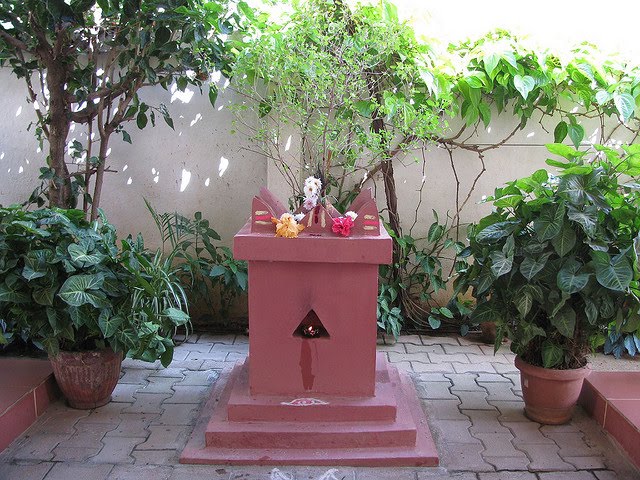
What is the spiritual significance of Tulasi Puja done on Utthana Dwadashi day ?
Tulasi puja is celebrated by performing marriage of Saligrama representing Vishnu and Tulasi representing the Prakriti – Nature. Tulasi Puja symbolizes the union of Universal consciousness and Nature Prakriti.
Saligrama stone is available in river Gandaki of Nepal is considered as sacred stone. Saligrama stones most ancient stone formations of the universe and is used as representation of Vishnu. Vishwam ( Vishnu Sahasranama) is the form of the Lord Vishnu and Saligrama represents symbolically the same.
Out of Vishnu Maya, the universe is projected. Tulasi represents the prakriti – maya aspect. Tulasi being a medicinal plant also represents the healing aspect of nature.
What is the spiritual significance of Uthana Dwadashi ?
Utthana represents waking up. It is the day Lord Vishnu who was sleeping in yoga nidra woke up on that day. Lord Vishnu uses the Maya for the creation of the Universe. He is not affected by the maya. But individual soul – jivatma is trapped in maya. This maya which traps individual soul is called avidya maya. Individual soul is nothing but the reflected consciousness of the Lord Vishnu – Vasudeva as sakshi inside us. Shri Vishnu is the Bimba – original and the sakshi in the individual soul is the pratibimba. Uthana dwadashi at the individual level is waking up from ignorance of maya. The individual soul finding the Vasudeva in him. Realizing the Sakshi.
What is the spiritual meaning of Dwadashi ?
Dwadashi means twelve. Sanskrit is a beautiful language . It communicates dual meanings in single word. Dwa – dashi also means two ways. We have two paths – outward and inward. We have two purposes – outer and inner. Dwadashi is the day we chose one of these. We see the world outside and seek happiness. This becomes our outer purpose. The inner purpose of life is to seek the Lord within. Lord Vasudeva – Sakshi inside us. Excessive focus on getting happiness from the outer world makes us demonic (asuric) in nature and focusing on the inner Self makes us divine (devas). These qualities are described in chapter 16 of Bhagavadgita.
What is the spiritual meaning of killing shanka chuda sura by Shri Vishnu ?
Again Sanskrit wordings communicate dual meaning. Shanka stands for conch and also shanka stands for – doubt. At the individual level shanka sura is the demonic nature in jiva creating doubts. Shankasura or doubts get killed when we read Shastras – scriptures which tell our essential nature as divine. Shastras are nothing but words of Lord Vishnu – Vishnu himself. Killing of Shankasura represents the destruction of ignorance by reading scriptures and removal of ignorance by Sadguru who is one with the Lord Vishnu.
At the cosmic level – shanka represents the conch. Conch is symbolic of the Omkar – primodial sound. Killing the primodial sound is bringing into manifestation of the universe. Conch is used as sacred object in Tulasi puja.
What is the significance of Tulasi ?
Tulasi is the medicinal plant which cures many diseases. All the plants take carbon dioxide and produce oxygen. Tulasi plant does it more efficiently. Hence having Tulasi in house is considered as auspicious. Tulasi puja also represents our respect for nature which is nothing but manifestation of maya of Lord Vishnu.
Tulasi represents the healing aspect of nature. While nature binds jiva with avidya maya, nature also provides individual soul chance for liberation in the form of Vidya maya. Mind which is purified and is full of satva.
Tulasi puja is celebrated by performing marriage of Saligrama representing Vishnu and Tulasi representing the Prakriti – Nature. Tulasi Puja symbolizes the union of Universal consciousness and Nature Prakriti.
Saligrama stone is available in river Gandaki of Nepal is considered as sacred stone. Saligrama stones most ancient stone formations of the universe and is used as representation of Vishnu. Vishwam ( Vishnu Sahasranama) is the form of the Lord Vishnu and Saligrama represents symbolically the same.
Out of Vishnu Maya, the universe is projected. Tulasi represents the prakriti – maya aspect. Tulasi being a medicinal plant also represents the healing aspect of nature.
What is the spiritual significance of Uthana Dwadashi ?
Utthana represents waking up. It is the day Lord Vishnu who was sleeping in yoga nidra woke up on that day. Lord Vishnu uses the Maya for the creation of the Universe. He is not affected by the maya. But individual soul – jivatma is trapped in maya. This maya which traps individual soul is called avidya maya. Individual soul is nothing but the reflected consciousness of the Lord Vishnu – Vasudeva as sakshi inside us. Shri Vishnu is the Bimba – original and the sakshi in the individual soul is the pratibimba. Uthana dwadashi at the individual level is waking up from ignorance of maya. The individual soul finding the Vasudeva in him. Realizing the Sakshi.
What is the spiritual meaning of Dwadashi ?
Dwadashi means twelve. Sanskrit is a beautiful language . It communicates dual meanings in single word. Dwa – dashi also means two ways. We have two paths – outward and inward. We have two purposes – outer and inner. Dwadashi is the day we chose one of these. We see the world outside and seek happiness. This becomes our outer purpose. The inner purpose of life is to seek the Lord within. Lord Vasudeva – Sakshi inside us. Excessive focus on getting happiness from the outer world makes us demonic (asuric) in nature and focusing on the inner Self makes us divine (devas). These qualities are described in chapter 16 of Bhagavadgita.
What is the spiritual meaning of killing shanka chuda sura by Shri Vishnu ?
Again Sanskrit wordings communicate dual meaning. Shanka stands for conch and also shanka stands for – doubt. At the individual level shanka sura is the demonic nature in jiva creating doubts. Shankasura or doubts get killed when we read Shastras – scriptures which tell our essential nature as divine. Shastras are nothing but words of Lord Vishnu – Vishnu himself. Killing of Shankasura represents the destruction of ignorance by reading scriptures and removal of ignorance by Sadguru who is one with the Lord Vishnu.
At the cosmic level – shanka represents the conch. Conch is symbolic of the Omkar – primodial sound. Killing the primodial sound is bringing into manifestation of the universe. Conch is used as sacred object in Tulasi puja.
What is the significance of Tulasi ?
Tulasi is the medicinal plant which cures many diseases. All the plants take carbon dioxide and produce oxygen. Tulasi plant does it more efficiently. Hence having Tulasi in house is considered as auspicious. Tulasi puja also represents our respect for nature which is nothing but manifestation of maya of Lord Vishnu.
Tulasi represents the healing aspect of nature. While nature binds jiva with avidya maya, nature also provides individual soul chance for liberation in the form of Vidya maya. Mind which is purified and is full of satva.
Saturday, November 6, 2010
Celebration of Life - Festival of Holi

Coming after Shivaratri Festival, Holi brings the message of life.
Shivaratri stands for waking up from the dream. Waking up to reality.
Holi shows the way. Holi is celebrated with splashing of colours and
burning of Kama. Symbolicing the Upanishadic ( Ishavasya), Tena Tyaktena
Bhunjitaha - Enjoy with renunciation.
*Tena Tyaktena Bhunjitaha*
**
Isha Vasya upanishat says "Enjoy with renunciation". How can someone enjoy
with renunciation. How is it possible. Everything in the Universe belongs to
the Lord - Ishvara. There is nothing which belongs to anybody. If we look at
our body, mind, intellect complex, space, water, fire, earth everything is
Prakriti- Nature. Nature belongs to Ishvara. We have been given this body,
this mind, intellect to experience the Prakriti. In forgetfulness, we start
assuming ownership. We say my body, we say my mind, we say my intellect and
gradually, we start experiencing I am body. Then we start accumulating. My
property, my house... . There is no such thing. Everything belongs to
Ishvara. We are given the right to use body for a limited duration. Body is
like a rented house. The moment we start claiming ownership of the rented
house, we are in trouble. In universal terms, the trouble is called karma.
Suffering starts.
We have to understand that we have been given right to use but not
ownership. We are trustees of everything given by Lord - Ishvara.
We need to take good care of the nature, our body mind complex and live
greatfully, for all the grace We have to renounce ownerhsip and live in joy,
celebration with all that is given to us. This is the spirit of Holi.
*Spirit of Holi*
**
Holi involves celebration of life - splashing of colours. Burning of Kama.
- Symbolising renunciation of what is not ours and in the process
experiencing the bliss of life, joy of life.
*Story of Holi Festival - Story of Holika*
**
According to Narad Purana, this day is celebrated in the memory of Prahlad’s
victory and the defeat of his aunt ’Holika’. The legend says that there once
existed a mighty demon king by the name of Hiranyakashyap who wished that
everybody in his kingdom should worship him. However, his son, Prahlad
became a worshipper of Lord Vishnu. He tried every way to stop Prahlad from
worshipping Vishnu but could not succeed. Out of frustration and anger, the
demon king then decided to kill his son. Despite all his efforts, Prahlad
remained safe by the blessings of Lord Vishnu.
Finally, Hiranyakashyap instructed his sister, Holika to sit in the burning
fire with Prahlad in lap. She was blessed with a boon, as a result of which
no fire could burn her. But the opposite happened, Prahlad survived and
Holika was charred to death. This incident thus re-established the faith of
people in the ultimate divine power and is thus celebrated as the day of
eternal love, devotion, blessings and the victory of Good over evil. It is
because of this event, Holika (a bonfire) is burnt every year on Holi. The
burning of the effigy of Holika is called Holika Dahan.
*Spiritual Meaning of the Story of Buring of Holika. - Mandukya Upanishad*
**
Hiranya kashyap - stands for desire ridden individuals - Hiranya means gold.
Kashyapu - means pillow. Somebody whose sleep is disturbed by desire for
possessions and wealth. He becomes Asura - demonic. Disturbing the society
and himself. Prahlad is child - a
opening in the heart for the Lord - Supreme Bliss ( Pra-Ahlada). The desire
ridden ego suppresses the child. Even tries to kill through holika ( the
anger). But lord protects the child and shows himself in the form of
Narasimha - Neither man, nor animal, neigher inside nor outside, neighter
darkness, nor light ( Na antha prajnaha, Na bhahish prajan ) - Turiya state
of conciousness. Practice of Turiya, - Samadhi - 4th state of conciousness -
kills the ego - Hiranyakashyap and Holika.
Burning of Holika is symbolic of Tapasya - Spiritual practices. Tapasya
means heat - Heat of spiritual practices of - Kaya, vacha, manasa tapasya
burns Holika - Anger - sister of ego.
*Spiritual Meaning of Kamadahana - Jnanagni Dagda Karmani - Bhagavadgita*
There is another legend that is also attributed to the origin of Holi. This
story is about Kamadeva, the god of love. Kama’s body was destroyed when he
shot his weapon at Shiva in order to disrupt his meditation and help Parvati
to marry Shiva. In anger for disrupting his meditation, Shiva opened his
third eye, the gaze of which was so powerful that Kama’s body was reduced to
ashes. For the sake of Kama’s wife Rati (passion), Shiva restored Kamadeva
only as a mental image, representing the true emotional and spiritual state
of love rather than physical lust. It is also believed that the Holi bonfire
is lit in commemoration of this event.
*Spiritual Meaning of Burning Of Kamadeva*
**
Shiva is Adi Guru. Destroyer of Ignorance. Opening of third eye represents
- wisdom. Wisdom gained through Shastra (Scriptures), Sadguru (Enlightened
Master) and Atmaguru (The Inner Self)
*Story of Shri Krishna and Gopikas*
In Vrindavan and
Mathura,where Lord Krishna grew up, the
festival is celebrated for 16 days (until Rangpanchmi in commemoration of
the divine love of Radha for Krishna).
Lord Krishna is believed to have popularized the festival by playing pranks
on the gopis here. Krishna is believed
to have complained to his mother about the contrast between his dark skin
complexion and Radha's (Shakti or energy that drives the world) fair skin
complexion. Krishna's mother decided to apply colour to Radha's face. The
celebrations officially usher in spring, the celebrated season of love*.*
*Spiritual Meaning of the story :* Shri Krishna represents the Paramatman.
Gopikas represents the Jivatman. Radhika represents the Prakriti. The deep
love of Gopikas and Bhagavan and the play is Rasa lila. Colours represents
the animation of the Prakriti and Jivatman by Paramatman.
Path of Liberation - Uttarayana

Wish you all very Happy Makara Sankranti. Makara Sankranti is a festival for our commitment to Moksha - liberation through the performance of Selfless Service - Nishkama karma.
What is cosmic significance of festival of Makara Sankranti ?
Makara sankranti is the day sun starts northward movement. It is called Uttarayana. Our ancestors considered 6 months of Uttarayana as day for devas – cosmic beings and 6 months of dakshinayana as night for cosmic beings.
What is Spiritual significance of Makara Sankranti.
Makara Sankranti is a festival which reminds us the purpose of human life and the paths available for human beings. Dharma, Artha, kama and moksha are called purusharthas – basic motivation for life. Of these, moksha or liberation is the highest purushartha. Shri Krishna in Bhagavadita 8.24 and 8.25 speaks of two paths - Uttarayana marga and dakshinayana marga. These are also called path of Gods and path of ancestors. The other names for these two paths are archiradi marga ( path of light) and dhumradi marga ( path of darkness).
Uttarayana Marga specifies the path taken by departed souls after death. Those souls who have lived a path of selfless service – nishkama karma take the path of Uttaradi Marga for liberation. While those people who are engaged in kamya karma – action with desires take the path of dakshinayana marga – path of return/path of bondage.
Makara Sankranti festival reminds us the highest goal of Moksha and paths for the same as told by Shri Krishna in Bhagavadgita.
What is the significance of customs followed in celebration of Makara Sankranti ?
Exchange of sesame seeds (Til) and jaggery - Sesame (til) symbolizes the karma. Black Sesame seed burnt in front of Shaneshwara temple symbolizing burning of negative karma. On the eve of Makara sankranti white sesame seed is distributed along with jiggery symbolizing performance of good karma in the form of yajna. This is symbolic representation of working towards nishkama karma – selfless service for purifying oneself and working towards liberation/mukti.
Exchange of sugar dolls – Sugar dolls represent the souls purified through nishkama karma. They have become sweet and ready to melt into ocean of divine Bliss – Ananda and experience Brahmananda – eternal bliss of liberation. These souls are ready to travel on the path of Uttarayana/path of light/path of Gods.
Divine Light in temples - In some temples devotees worship the divine light in the form of flame. This symbolizes the path of light to be taken by devotees for liberation. This is called archiradi marga/uttarayana marga.
What is path of light and path of darkness ?
There are two paths for the soul after death [1,2]
a). Path of light ( Archiradi marga).
b). Path of darkness ( Dhumradi marga).
Soul which takes the path of light attains immortality. Such a soul does not take rebirth. Souls which take the path of darkness are reborn into phenomenal existence.
What is path of Gods and path of Ancestors ?
Vedic literature often speaks of two paths for the departed soul.
a). Path of Gods (devayana)
b). Path of ancestors (pitruyana)
The word deva comes from the root div which means light. Devayana refers to path of light. Pitruyana refers to the path of ancestors. This is a representation of all the mortal souls and hence represents the path of darkness.
What is the meaning of path of light and path of darkness ?
Light stands for knowledge. Light stands for wisdom. One who has the wisdom of the Inner Self (Atma) is on the path of Light. One who has ignorance of the Inner Self (Atma) is on the path of darkness. Thus the path of light and path of darkness stand for path of wisdom (jnana) and path of ignorance ( ajnana).
What happens to souls on the path of darkness ?
The souls who are on the path of darkness are bound by law of karma. Based on their karmic impressions they attain heaven ( swarga ). After the enjoying the fruits of of good karma they are reborn on the earth [3]. If the soul has done good karma in previous birth, it takes birth (uccha yonis) in higher vehicles like brahmana, kshatriya etc. Otherwise, soul gets reborn in lower vehicles (neecha yonis) like animals. Chandala etc. [4]
What happens to souls who donot follow the path of light/darkness ? The souls who donot follow the path of light or path of darkness fall into third category. They are subjected to a life of transmigratory existence of repeated births and deaths and experience life as mixture of joys and sorrows [4].
What happens to souls who are enlightened ?
Souls who are enlightened are called jivanmuktas. They become one with Brahman. Like a salt doll which went to measure depth of the sea, disappears, individual soul merges into universal consciousness. For such a soul, there is no transmigration, no devayana and no pitruyana. After death, such a person is called videha mukta. Pranas of such a soul donot depart from the body.
[1]Path of Light
agnir jyotir ahah suklah san masa uttarayanam tatra prayata gacchanti brahma brahma-vido janah ( Bhagavadgita 8.24)
Those who know the Supreme Brahman attain that Supreme by passing away from the world during the influence of the fiery god, in the light, at an auspicious moment of the day, during the fortnight of the waxing moon, or during the six months when the sun travels in the north.[2] Path of Darkness
dhumo ratris tatha krsnah san-masa daksinayanam tatra candramasam jyotir
yogi prapya nivartate (Bhagavadgita 8.25)
The mystic who passes away from this world during the smoke, the night, the fortnight of the waning moon, or the six months when the sun passes to the south reaches the moon planet but again comes back.yogi prapya nivartate (Bhagavadgita 8.25)
[3]Heaven
Te tam bhuktva svarga-lokam visalam kshine punye,martya-lokam visanti evam trayi-dharmam anupassana gatagatam kama kama labhate – Bhagavadgita 9.21
When they have thus enjoyed vast heavenly sense pleasure and the results of their pious activities are exhausted, they return to this mortal planet again. Thus those who seek sense enjoyment by adhering to the principles of the three Vedas achieve only repeated birth and death.
[4] Rebirth
Chandogya Upanishad 5.10.7,5.10.8
Subscribe to:
Posts (Atom)